What Metal Stamping Services Include: From Drawing Review to Final Delivery
If you have never ordered stamped parts before, the process can feel like a black box. You send a drawing, a price comes back, and some weeks later a box of finished parts arrives. In reality, a lot happens in between, and understanding those steps makes you a better buyer. You will know what to ask, where delays can appear and how to avoid expensive mistakes.
This article walks through what professional metal stamping services typically involve, step by step.
What metal stamping actually is
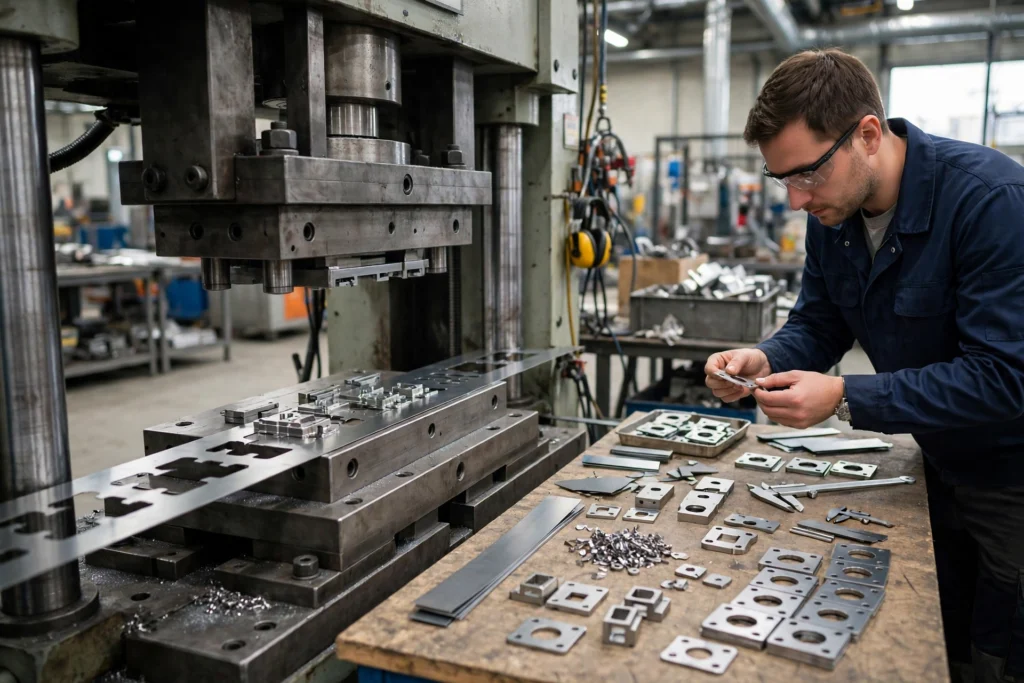
Metal stamping is a manufacturing process in which a press and a die shape flat sheet metal into a finished part. The die works like a very precise cutter and mold. Depending on the design, the press can punch holes, cut the outline, bend edges or form three dimensional shapes, often in a single continuous run. Because the process is fast and repeatable, it is widely used wherever large numbers of identical metal parts are needed.
Step 1: Drawing and requirements review
Everything starts with your drawing and your technical requirements. A good manufacturer does not simply read the numbers. The engineers check whether the part can actually be produced as drawn, whether any tolerance is unrealistic for the chosen material, and whether a small design adjustment could make production easier or cheaper. This early review is one of the most valuable parts of the whole process, because a problem found on paper costs almost nothing compared with a problem found after the tool is built.
Step 2: Tooling design
Next, the engineering team designs the tooling. For many small precision parts this means a progressive die, in which the metal strip passes through a series of stations and is shaped a little at each one until the finished part is cut free. Good tooling design takes into account the material, the thickness, how much the metal will spring back after bending, how scrap will be removed and how the die can be maintained over its life.
Step 3: Die manufacturing
Once the design is approved, the die is built from hardened tool steel using precision machining. Accuracy here matters enormously, because any error in the die is repeated in every single part. Manufacturers that build dies in house can usually adjust and repair them faster, which helps keep projects on schedule.
Step 4: Prototype and trial runs
Before full production begins, sample parts are made and tested. This stage confirms that the dimensions, fit and performance meet your requirements. If something needs to change, it is far better to find out now. Prototype testing is also when the production process is fine tuned, such as adjusting press settings and checking how the material behaves.
Step 5: Stamping production
With the tool approved, the press runs the job. Alongside punching and forming, many stamped parts need extra operations such as bending and riveting. Hashimoto Precision, for instance, lists bending, riveting, punching and forming among its stamping processes, together with customized stamping operations based on a customer’s design and material.
Step 6: Quality inspection
Inspection happens throughout production and again at the end. Operators check critical dimensions at set intervals, and finished parts are verified against the drawing. Measuring tools range from simple gauges to precision optical equipment, depending on how tight the tolerances are. Ask your supplier what inspection records you will receive, since these give you evidence that every batch meets the specification.
Step 7: Packaging and delivery
This last step is often underestimated. Small precision parts can be damaged by careless packing, so the packaging should protect them from scratches, deformation and contamination. Some small components are supplied on carrier tape for automated assembly lines. Agree on packaging details before production starts, and confirm delivery schedules so your own assembly line is never left waiting.
Why one stop support makes a difference
When design review, tooling, production and inspection all sit within a single organization, information flows easily and responsibility is clear. If something goes wrong, there is no finger pointing between separate companies. Reliable metal stamping services that cover the whole journey from drawing to delivery can shorten development time and help keep quality consistent from the first sample to the last shipment. According to its website, Hashimoto Precision follows this seven step approach, from drawing review through to packaging and delivery.
Tips for getting more from your supplier
Give complete information in your first enquiry. Include your drawing, material, thickness, estimated annual quantity and any special requirements. Be honest about which tolerances are truly critical, because tightening every dimension makes parts more expensive without making them better. Ask for samples before committing to large volumes, and keep communication open throughout the project. Suppliers do their best work when they understand how the part will actually be used.
Final thoughts
Metal stamping looks simple from the outside, but it is a carefully managed chain of engineering decisions. Understanding each stage helps you plan better, budget more accurately and choose a partner with confidence. Take time over the early steps, because they have the greatest influence on cost, quality and delivery. A well prepared project, supported by an experienced supplier, is the surest way to get reliable parts on time.