Why Big Plastic Parts Need a Robot Built for the Job
Think about the plastic parts that people rarely pay attention to: a car bumper, the side panel of a washing machine, the housing of a refrigerator, a heavy shipping pallet. They are wide, awkward and often deep. Somebody has to take them out of the mold after every cycle, and doing it by hand is slow, tiring and not always safe.
That is the situation around every large injection molding machine. The mold is large, the part is large, and the equipment that handles the part needs to be designed with that scale in mind. A robot made for small parts on a small machine simply does not solve the same problem.
What “large” means in practice
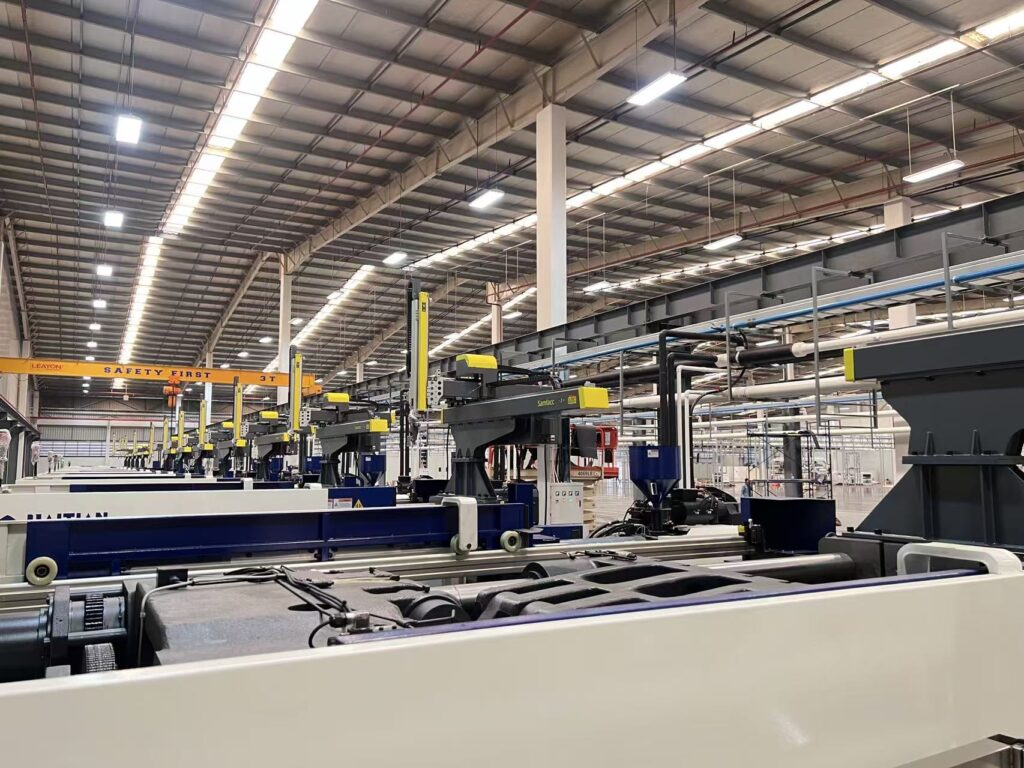
The Samfacc Large Range Robot SFN Series, made by Foshan Samfacc Robot Co., Ltd in Guangdong, China, is listed on its product page for injection molding machines from 900 to 3500 tons. That gives a useful picture of the scale involved. It is a different world from the machines of 90 to 400 tons that the same company covers with its high-speed series.
How the robot is built
According to the manufacturer, the SFN series is an open-type servo robot with a single arm. The standard version is telescopic with a double-cut open design. The page describes it as servo driven with three to five axes, although it is worth knowing that one part of the page mentions three axes while another says three to five, so confirm the exact configuration with the supplier.
The double-stage arm uses a belt-driven double-speed mechanism. The manufacturer says this raises running speed and also lowers the height the workshop needs to provide. That second point matters in a real factory. Large machines are tall, and a robot that demands even more ceiling clearance can turn a simple installation into a building project.
The cycle time
The product page gives a take-out cycle time of 10 to 15 seconds. That is slower than the 3 to 10 second range given for the company’s high-speed series, which makes sense. Large parts move through longer cooling and handling stages, and a heavy part cannot be whipped out of a mold the way a thin electronic component can. What matters is that the robot’s movement is steady and repeatable, so that the whole line stays predictable.
Where it is used
The manufacturer lists these applications for the series:
Automotive plastic parts such as bumpers and trim. Large appliance housings, including washing machine panels, refrigerator housings and air conditioner covers. Large or heavy plastic pallets and containers. Long-strip or wide-area parts, and deep molds with large cavities. The page also mentions continuous high-output production lines.
Notice what these have in common. They are bulky rather than delicate, and the mold often has a deep or wide opening that the arm has to reach into and out of cleanly.
Control and ease of use
Even the biggest robot is only useful if people can run it without a long learning curve. The page describes a touch-screen operating system with 100 sets of mold memory, 18 groups of standard programs and 80 groups of user programs. Mold memory is practical in plants that change molds from time to time, because earlier settings can be recalled instead of being rebuilt.
The manufacturer also says it provides manuals, program guidance videos and PowerPoint process guides, and that operators can learn the system in as little as half a day. It states that more than 30 technicians offer real-time support, and that customisation of stroke length, grippers and program logic is available.
Quality claims worth asking about
The page says each robot is test run for 24 to 36 hours before shipping, and that parts are sourced from Japan, Germany, France and Taiwan. It also lists ISO 9001 and CE certification. These are the manufacturer’s own statements, so a careful buyer will ask to see the certificates and to speak with a customer who has used the robot on a similar machine.
What the page does not tell you
To be fair, the product page does not list payload, stroke or reach, power requirements, dimensions or weight. For a heavy part, those are exactly the numbers that decide whether a robot is suitable. Before you commit, give the supplier your part weight, mold size and machine model, and ask for these figures in writing.
Summary
A big part on a big machine is a handling problem as much as a molding one. A robot designed for that scale, with a suitable arm structure, sensible cycle time and simple controls, takes a hard physical job off people and makes the line steadier. Just make sure the details match your machine before you buy.