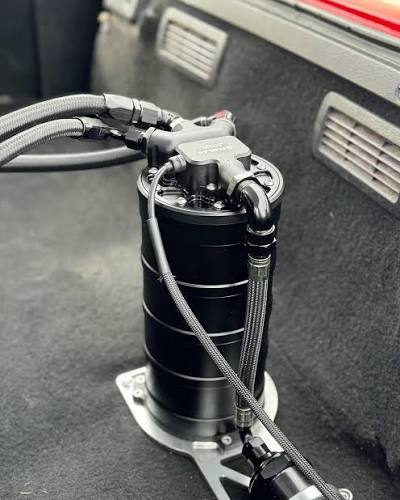
Fuel Surge Tank: how it works And Why it Matters
A performance car can have a strong engine and a careful tune, and still kind of pause or stumble in the middle of a fast corner. When that shows up, it’s not always some mystery buried under the hood. Sometimes fuel has just shifted away from the pickup inside the main tank. A fuel surge tank is there to stop that brief but potentially sketchy loss of fuel delivery.
What Is a Fuel Surge Tank ?
A fuel surge tank is a small secondary reservoir added to the vehicle’s fuel setup. It does not replace the original tank. Instead it sits there holding a separate reserve of fuel that the engine can use when things get rough like hard acceleration , sudden braking, or cornering loads.
Fuel sloshes around inside the main tank every time the vehicle’s motion changes. If the fuel level is low enough, that motion can leave the pickup uncovered for a moment. Then the pump may pull in air, not fuel. Since a surge tank stays relatively full and is smaller, it gives the high-pressure pump a steadier supply.
How Does a Fuel Surge Tank Work ?
In a common layout, a lift pump sends fuel from the main tank into the surge tank. Then a high-pressure pump draws from the surge tank and pushes fuel to the engine. In many designs, leftover fuel returns to the reservoir, and any overflow eventually heads back to the main tank as well.
This arrangement keeps a small “ready” amount of fuel near the high-pressure pump. So if the main pickup gets briefly uncovered during a corner , the engine keeps pulling from the surge tank. Fuel pressure stays more consistent, and the driver is less likely to notice that sudden hesitation.
Understanding Fuel Starvation
Fuel starvation is when the engine does not get the amount of fuel it needs to run right. You notice it most during demanding driving, like on a racetrack or a drift course. Long corners push fuel to one side of the tank, hard braking shoves it forward, and quick acceleration can drag it toward the rear.
When the pump starts ingesting air, the engine can stumble, misfire or lose pulling power. The issue may vanish the instant the car straightens and fuel covers the pickup again. That weird “comes and goes” behavior makes it easy to confuse with a weak pump, an ignition fault, or even just poor tuning.
Also, even a short interruption can be extra risky on a turbocharged engine running under boost. With not enough fuel, the air-to-fuel mixture can swing lean, and combustion temperatures can climb. A fuel surge tank helps lower that risk by keeping fuel available and pressure more stable.
Who Might Need a Fuel Surge Tank ?
Surge tanks show up a lot on track cars, drift cars, and other competition machines. Still, they can help on modified road cars too. If a vehicle has a bigger turbo, upgraded injectors, or higher boost than stock, it may burn through fuel faster than the factory system ever expected.
A larger pump in the main tank can improve potential flow, but it cannot supply fuel if its inlet is exposed to air. So a pump upgrade alone doesn’t always fix starvation. The surge tank targets the movement of fuel, not just the pump size.
Choosing a Suitable Setup
The best configuration depends on engine output, fuel type, and how the car is actually driven. The lift pump has to refill the surge reservoir fast enough, and the pressure pump must be able to deliver the needed flow at maximum load. It’s smart to verify pump capability at your intended operating pressure, not just rely on the advertised top flow number.
Fuel compatibility matters too. If you’re running E85, pumps, seals, hoses, and fittings must tolerate ethanol. Tank capacity and mounting space are also a factor. A bigger reservoir is not always better if it cannot be mounted safely or protected properly.
Installation and Safety
A fuel surge tank should be firmly secured, kept away from intense heat, and protected from impact. Fuel lines should be routed in a safe way , and every connection has to match the pressure rating it will see. Pumps also need the right wiring, relays, and fuses sized so the system stays stable without voltage drop or overheating.
If the reservoir is installed inside a cabin or luggage area, local road rules or motorsport rules may require an enclosure, ventilation, or a firewall barrier. If you don’t have experience with performance fuel systems, it’s better to have a qualified professional do the work. After install, the full setup should be inspected for leaks and tested to confirm stable fuel pressure.
Does It Add More Power ?
A fuel surge tank doesn’t magically create horsepower by itself. The point is reliability: it helps the engine deliver the power it already makes, without fuel delivery dropping during aggressive driving. If fuel pressure dips in a hard corner or during a launch, removing that interruption often makes the car feel smoother and more predictable.
And it’s crucial to treat the surge tank as only one piece of a full fuel system. It cannot cover problems like injectors that are too small, a pump that’s truly undersized, or an incorrect tune. Every component has to align with the engine’s fuel demand.
Final Thoughts
A fuel surge tank is a clean, practical solution for a problem that tends to appear exactly when a car is being driven hard. By keeping a replenished “buffer” reserve, it protects the high-pressure pump from the effects of fuel sloshing in the main tank.
For a track build, drift machine, or high-powered street setup, that extra consistency can matter a lot. With properly matched pumps, OSIAS safe fuel lines, and a careful installation, a surge tank helps the engine stay supplied through acceleration, braking and those fast corners where fuel movement can otherwise cause trouble.